Neural network definitions in pytorch
Explicit network definition
# Sum  = [[x1 x2 ... xn],] * [[w1 ...],] + [[b1 b2 ... bn]]
#         ...                 [w2 ...],
#                             ...
#                             [wn ...]
#
# Sum =        x         *        w       +       b

out = torch.mm(x,w) + b
nn.Linear network definition
out = torch.mm(x,w.T) + b[0]
2 inputs, 1 output
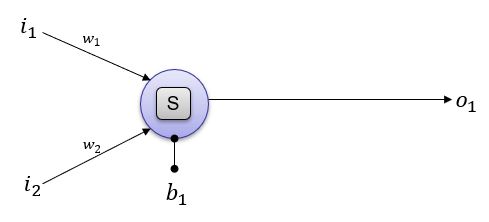
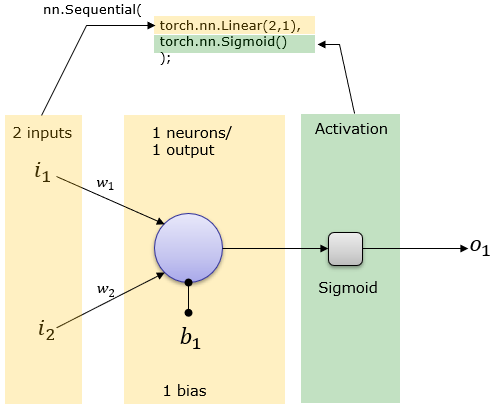
Explicit
see example
# Define the size of each layer in our network
n_input = 2    # Number of input units, must match number of input features
n_hidden = 1   # Number of hidden units
n_output = 1   # Number of output units

# Weights for inputs to hidden layer
w = torch.randn(n_input, n_hidden, dtype=torch.double, requires_grad=True)

# and bias terms for hidden and output layers
b = torch.randn(1, n_hidden, dtype=torch.double, requires_grad=True)

out = torch.nn.Sigmoid()(torch.mm(x,w)+(b))
Class+Explicit
see example
class NN:

    def __init__(self, n_input, n_hidden, n_output):

        # Weights for inputs to hidden layer
        self.w1 = torch.randn(n_input, n_hidden, dtype=torch.double, requires_grad=True)
        # and bias terms for hidden and output layers
        self.b1 = torch.randn(1, n_hidden, dtype=torch.double, requires_grad=True)
        self.activation = torch.nn.Sigmoid()

    def forward(self,x):
        o = self.activation(torch.mm(x,self.w1)+(self.b1))
        return o

net = NN(2,1,1)
out = net.forward(x)
Class+Linear
see example
class Network(nn.Module):
    def __init__(self):
        super().__init__()
        self.linear = nn.Linear(2,1)
        self.activation = nn.Sigmoid()

    def forward(self,x):
        o = self.linear(x)
        o = self.activation(o)
        return o

net = Network()
out = net(x)
#or
#out = net.forward(x)
Sequential+Linear
see example
#                   nn.Linear(input,neurons)

net = nn.Sequential(nn.Linear(2, 1),
                    nn.Sigmoid(),
                   )

out = net(x)
#or
#out = net.forward(x)
2 inputs, 2 output
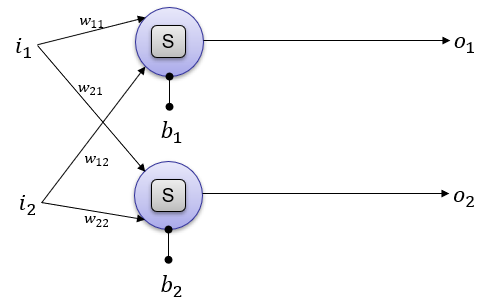
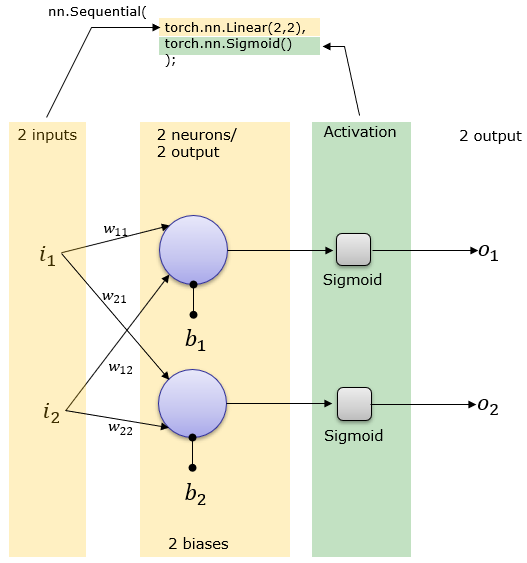
Explicit
see example
# Define the size of each layer in our network
n_input = 2    # Number of input units, must match number of input features
n_hidden = 2   # Number of hidden units
n_output = 2   # Number of output units

# Weights for inputs to hidden layer
w = torch.randn(n_input, n_hidden, dtype=torch.double, requires_grad=True)

# and bias terms for hidden and output layers
b = torch.randn(1, n_hidden, dtype=torch.double, requires_grad=True)

out = torch.nn.Sigmoid()(torch.mm(x,w)+(b))
Class+Explicit
see example
class NN:

    def __init__(self, n_input, n_hidden, n_output):

        # Weights for inputs to hidden layer
        self.w1 = torch.randn(n_input, n_hidden, dtype=torch.double, requires_grad=True)
        # and bias terms for hidden and output layers
        self.b1 = torch.randn(1, n_hidden, dtype=torch.double, requires_grad=True)
        self.activation = torch.nn.Sigmoid()

    def forward(self,x):
        o = self.activation(torch.mm(x,self.w1)+(self.b1))
        return o

net = NN(2,2,2)
out = net.forward(x)
Class+Linear
see example
class Network(nn.Module):
    def __init__(self):
        super().__init__()
        self.linear = nn.Linear(2,2)
        self.activation = nn.Sigmoid()

    def forward(self,x):
        o = self.linear(x)
        o = self.activation(o)
        return o

net = Network()
out = net(x)
#or
#out = net.forward(x)
Sequential+Linear
see example
net = torch.nn.Sequential(
  torch.nn.Linear(2,2),
  torch.nn.Sigmoid()
)
out = net(x)
2 inputs, 3 output
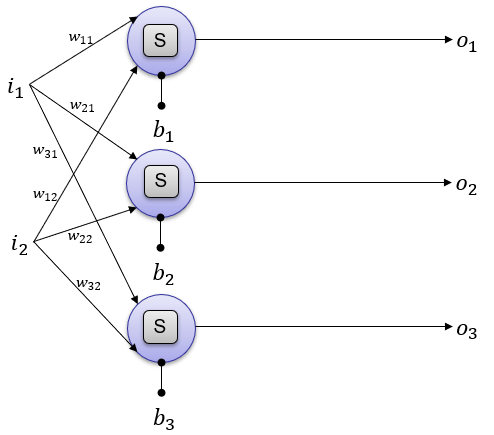
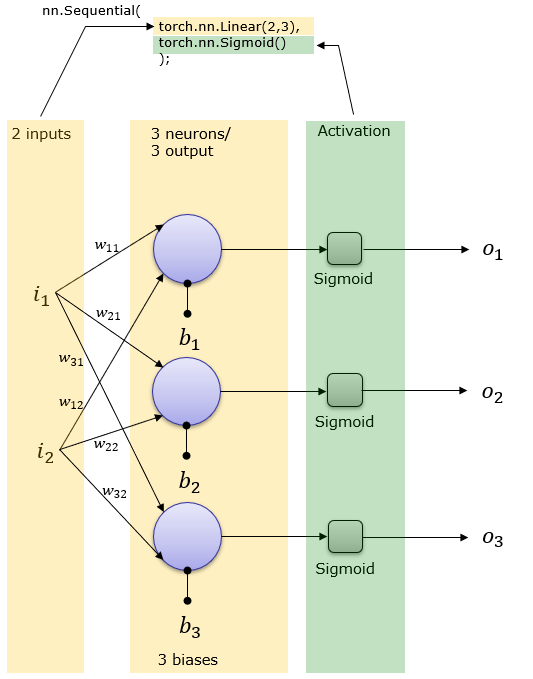
Explicit
see example
# Define the size of each layer in our network
n_input = 2    # Number of input units, must match number of input features
n_hidden = 3   # Number of hidden units
n_output = 3   # Number of output units

# Weights for inputs to hidden layer
w = torch.randn(n_input, n_hidden, dtype=torch.double, requires_grad=True)

# and bias terms for hidden and output layers
b = torch.randn(1, n_hidden, dtype=torch.double, requires_grad=True)

out = torch.nn.Sigmoid()(torch.mm(x,w)+(b))
Class+Explicit
see example
class NN:

    def __init__(self, n_input, n_hidden, n_output):

        # Weights for inputs to hidden layer
        self.w1 = torch.randn(n_input, n_hidden, dtype=torch.double, requires_grad=True)
        # and bias terms for hidden and output layers
        self.b1 = torch.randn(1, n_hidden, dtype=torch.double, requires_grad=True)
        self.activation = torch.nn.Sigmoid()

    def forward(self,x):
        o = self.activation(torch.mm(x,self.w1)+(self.b1))
        return o

net = NN(2,3,3)
print(net.forward(x))
Class+Linear
see example
class Network(nn.Module):
    def __init__(self):
        super().__init__()
        self.linear = nn.Linear(2,3)
        self.activation = nn.Sigmoid()

    def forward(self,x):
        o = self.linear(x)
        o = self.activation(o)
        return o

net = Network()
net.forward(x)
Sequential+Linear
see example
net = torch.nn.Sequential(
  torch.nn.Linear(2,3),
  torch.nn.Sigmoid()
  );

out = net(x)
3 inputs, 2 outputs
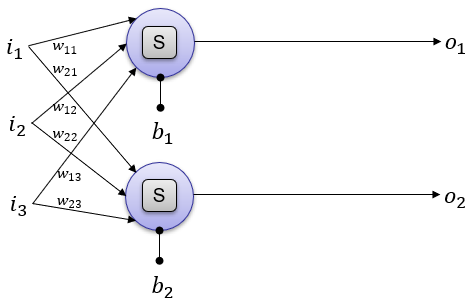
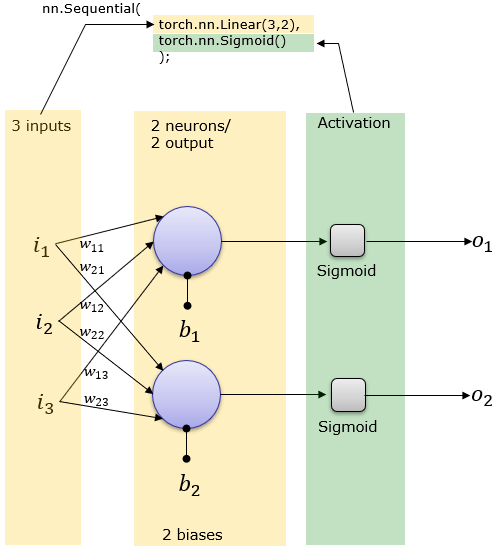
Explicit
see example
# Define the size of each layer in our network
n_input = 3    # Number of input units, must match number of input features
n_hidden = 2   # Number of hidden units
n_output = 2   # Number of output units

# Weights for inputs to hidden layer
w = torch.randn(n_input, n_hidden, dtype=torch.double, requires_grad=True)

# and bias terms for hidden and output layers
b = torch.randn(1, n_hidden, dtype=torch.double, requires_grad=True)

out = torch.nn.Sigmoid()(torch.mm(x,w)+(b))
Class+Explicit
see example
class NN:

    def __init__(self, n_input, n_hidden, n_output):

        # Weights for inputs to hidden layer
        self.w1 = torch.randn(n_input, n_hidden, dtype=torch.double, requires_grad=True)
        # and bias terms for hidden and output layers
        self.b1 = torch.randn(1, n_hidden, dtype=torch.double, requires_grad=True)
        self.activation = torch.nn.Sigmoid()

    def forward(self,x):
        o = self.activation(torch.mm(x,self.w1)+(self.b1))
        return o

net = NN(3,2,2)
out = net.forward(x)
Class+Linear
see example
class Network(nn.Module):
    def __init__(self):
        super().__init__()
        self.linear = nn.Linear(3,2)
        self.activation = nn.Sigmoid()

    def forward(self,x):
        o = self.linear(x)
        o = self.activation(o)
        return o

net = Network()
out = net(x)
#or
#out = net.forward(x)
Sequential+Linear
see example
net = torch.nn.Sequential(
  torch.nn.Linear(3,2),
  torch.nn.Sigmoid()
  );

out = net(x)
1 Hidden Layer : 2 neuron, 1 Output Layer
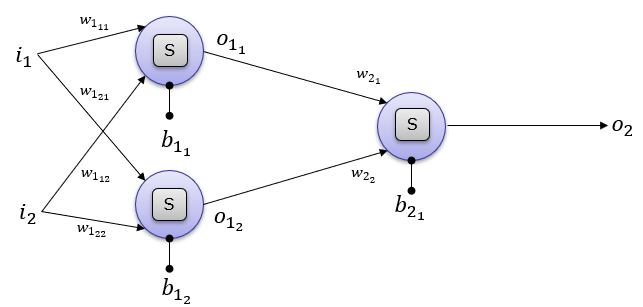
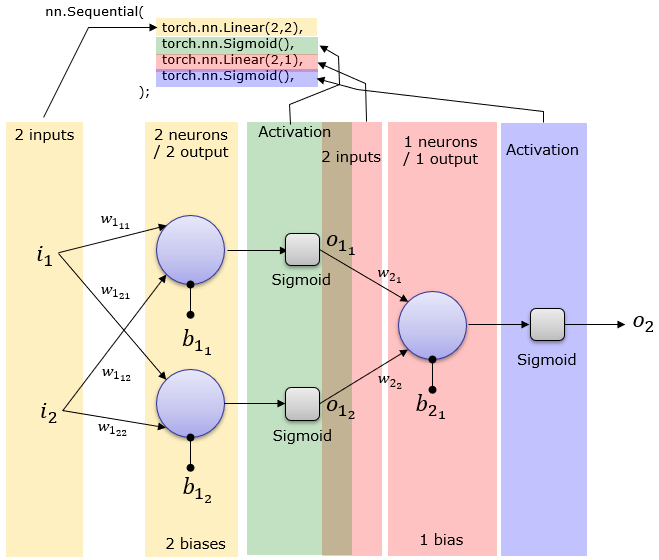
Explicit
see example
# Define the size of each layer in our network
n_input = 2    # Number of input units, must match number of input features
n_hidden = 2   # Number of hidden units
n_output = 1   # Number of output units

# Weights for inputs to hidden layer
w1 = torch.randn(n_input, n_hidden, dtype=torch.double, requires_grad=True)
# Weights for hidden layer to output layer
w2 = torch.randn(n_hidden, n_output, dtype=torch.double, requires_grad=True)

# and bias terms for hidden and output layers
b1 = torch.randn(1, n_hidden, dtype=torch.double, requires_grad=True)
b2 = torch.randn(1, n_output, dtype=torch.double, requires_grad=True)

h = activation(torch.mm(x,w1) + b1)
output = activation(torch.mm(h,w2) + b2)
Class+Explicit
see example
class NN():
    def __init__(self, n_input, n_hidden, n_output):

        # Weights for inputs to hidden layer
        self.w1 = torch.randn(n_input, n_hidden, dtype=torch.double, requires_grad=True)
        # Weights for hidden layer to output layer
        self.w2 = torch.randn(n_hidden, n_output, dtype=torch.double, requires_grad=True)

        # and bias terms for hidden and output layers
        self.b1 = torch.randn(1, n_hidden, dtype=torch.double, requires_grad=True)
        self.b2 = torch.randn(1, n_output, dtype=torch.double, requires_grad=True)

        self.activation = torch.nn.Sigmoid()

    def forward(self,x):
        o = activation(torch.mm(x,self.w1) + self.b1)
        o = activation(torch.mm(o,self.w2) + self.b2)
        return o

net = NN(2,2,1)
out = net.forward(x)
Class+Linear
see example
class Network(nn.Module):
    def __init__(self):
        super().__init__()
        self.linear1 = nn.Linear(2,2)
        self.linear2 = nn.Linear(2,1)

    def forward(self,x):
        o = self.linear1(x)
        o = torch.nn.Sigmoid()(o)
        o = self.linear2(o)
        o = torch.nn.Sigmoid()(o)
        return o

net = Network()
out = net.forward(x)
Sequential+Linear
see example
net = torch.nn.Sequential(
  torch.nn.Linear(2,2),
  torch.nn.Sigmoid(),
  torch.nn.Linear(2,1),
  torch.nn.Sigmoid()
  );
out = net(x)
1 Hidden Layer : 3 neuron, 1 Output Layer
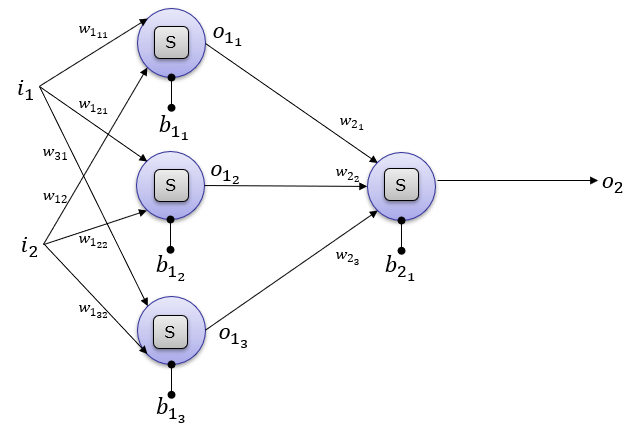
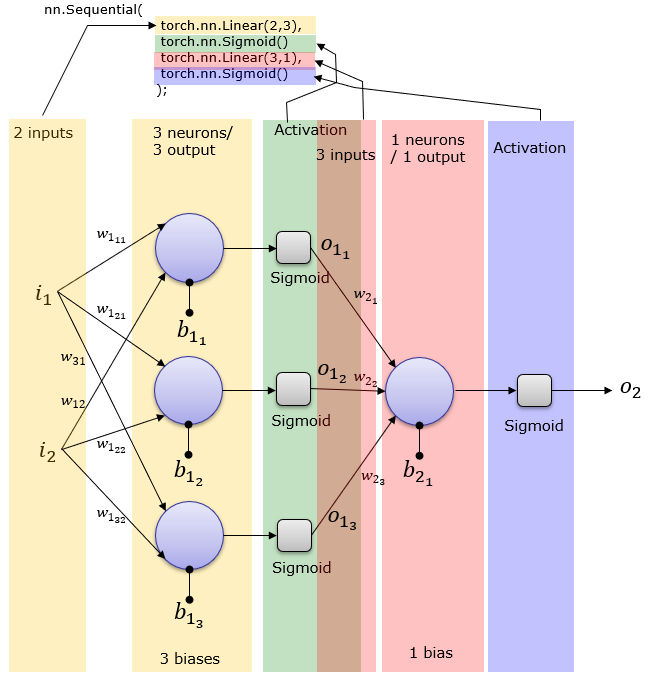
Explicit
see example
# Define the size of each layer in our network
n_input = 2    # Number of input units, must match number of input features
n_hidden = 3   # Number of hidden units
n_output = 1   # Number of output units

# Weights for inputs to hidden layer
w1 = torch.randn(n_input, n_hidden, dtype=torch.double, requires_grad=True)
# Weights for hidden layer to output layer
w2 = torch.randn(n_hidden, n_output, dtype=torch.double, requires_grad=True)

# and bias terms for hidden and output layers
b1 = torch.randn(1, n_hidden, dtype=torch.double, requires_grad=True)
b2 = torch.randn(1, n_output, dtype=torch.double, requires_grad=True)

h = activation(torch.mm(x,w1) + b1)
output = activation(torch.mm(h,w2) + b2)
Class+Explicit
see example
class NN():
    def __init__(self, n_input, n_hidden, n_output):

        # Weights for inputs to hidden layer
        self.w1 = torch.randn(n_input, n_hidden, dtype=torch.double, requires_grad=True)
        # Weights for hidden layer to output layer
        self.w2 = torch.randn(n_hidden, n_output, dtype=torch.double, requires_grad=True)

        # and bias terms for hidden and output layers
        self.b1 = torch.randn(1, n_hidden, dtype=torch.double, requires_grad=True)
        self.b2 = torch.randn(1, n_output, dtype=torch.double, requires_grad=True)

        self.activation = torch.nn.Sigmoid()

    def forward(self,x):
        o = activation(torch.mm(x,self.w1) + self.b1)
        o = activation(torch.mm(o,self.w2) + self.b2)
        return o

net = NN(2,3,1)
out = net.forward(x)
Class+Linear
see example
class Network(nn.Module):
    def __init__(self):
        super().__init__()
        self.linear1 = nn.Linear(2,3)
        self.linear2 = nn.Linear(3,1)

    def forward(self,x):
        o = self.linear1(x)
        o = torch.nn.Sigmoid()(o)
        o = self.linear2(o)
        o = torch.nn.Sigmoid()(o)
        return o

net = Network()
out = net.forward(x)
Sequential+Linear
net = torch.nn.Sequential(
  torch.nn.Linear(2,3),
  torch.nn.Sigmoid()
  torch.nn.Linear(3,1),
  torch.nn.Sigmoid()
);
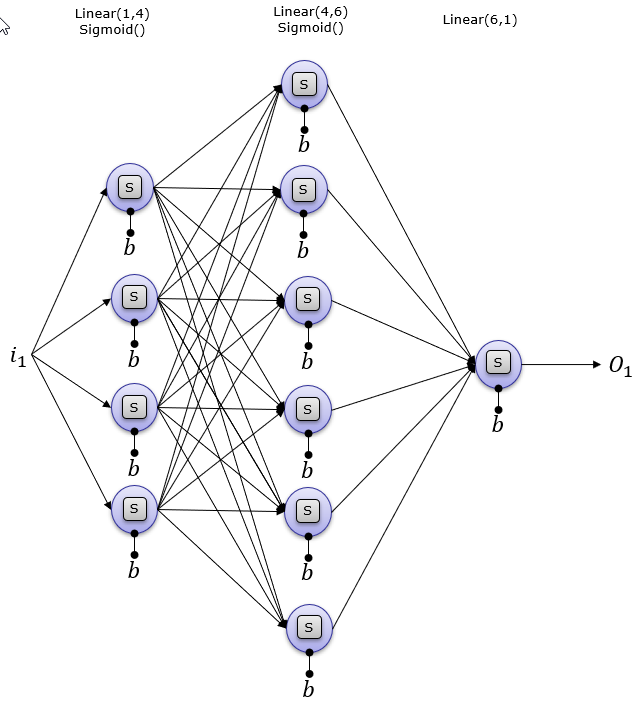
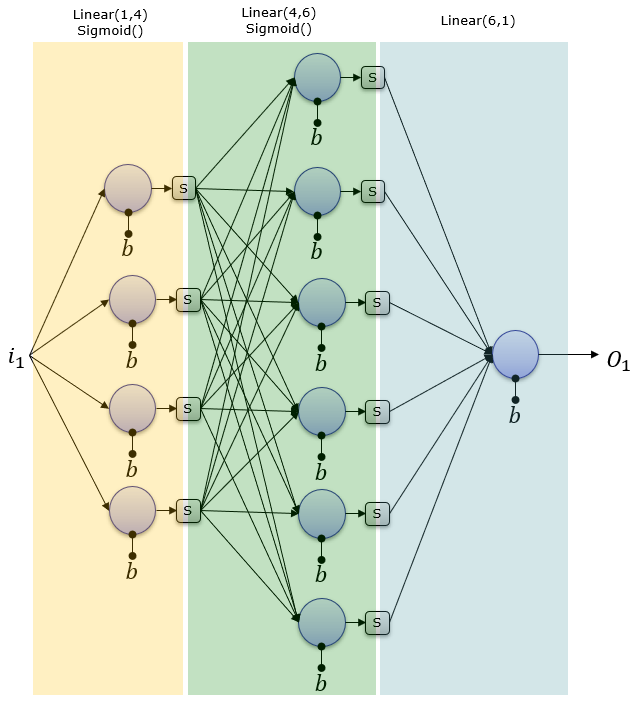
2 Hidden Layers : 4 and 6 Neurons, and 1 Output Neurons
Explicit
# Define the size of each network layer
n_input   = 1   # Number of input units, must match number of input features
n_hidden1 = 4   # Number of hidden units
n_hidden2 = 6   # Number of hidden units
n_output  = 1   # Number of output units

w1 = torch.randn(n_input,   n_hidden1, dtype=torch.float, requires_grad=True)
w2 = torch.randn(n_hidden1, n_hidden2, dtype=torch.float, requires_grad=True)
w3 = torch.randn(n_hidden3,  n_output, dtype=torch.float, requires_grad=True)

b1 = torch.randn(1, n_hidden1, dtype=torch.float, requires_grad=True)
b2 = torch.randn(1, n_hidden2, dtype=torch.float, requires_grad=True)
b3 = torch.randn(1,  n_output, dtype=torch.float, requires_grad=True)

o = torch.nn.Sigmoid()(torch.mm(x,w1)+(b1))
o = torch.nn.Sigmoid()(torch.mm(o,w2)+(b2))
o = torch.nn.Sigmoid()(torch.mm(o,w3)+(b3))

out = o
Class+Explicit
class NN:

    def __init__(self, n_input, n_hidden1, n_hidden2, n_hidden3, n_output):

        self.w1 = torch.randn(n_input,   n_hidden1, dtype=torch.float, requires_grad=True)
        self.w2 = torch.randn(n_hidden1, n_hidden2, dtype=torch.float, requires_grad=True)
        self.w3 = torch.randn(n_hidden2, n_output,  dtype=torch.float, requires_grad=True)


        self.b1 = torch.randn(1, n_hidden1, dtype=torch.float, requires_grad=True)
        self.b2 = torch.randn(1, n_hidden2, dtype=torch.float, requires_grad=True)
        self.b3 = torch.randn(1, n_output,  dtype=torch.float, requires_grad=True)


    def forward(self,x):
        o = torch.nn.Sigmoid()(torch.mm(x,w1)+(b1))
        o = torch.nn.Sigmoid()(torch.mm(o,w2)+(b2))
        o = torch.nn.Sigmoid()(torch.mm(o,w3)+(b3))

        return o

net = NN(1,4,3,2,1)

out = net.forward(x)
Class+Linear
class Network(nn.Module):
    def __init__(self):
        super().__init__()
        self.linear1 = nn.Linear(1,4)
        self.linear2 = nn.Linear(4,6)
        self.linear3 = nn.Linear(6,1)

    def forward(self,x):
        o = torch.nn.Sigmoid()(self.linear1(x))
        o = torch.nn.Sigmoid()(self.linear2(o))
        o = torch.nn.Sigmoid()(self.linear3(o))
        return o

net = Network()
out = net(x)
Sequential+Linear
net = torch.nn.Sequential(
  torch.nn.Linear(1,4),
  torch.nn.Sigmoid(),
  torch.nn.Linear(4,6),
  torch.nn.Sigmoid(),
  torch.nn.Linear(6,1),
  torch.nn.Sigmoid()
);
Reference:
http://www.sharetechnote.com/html/Python_PyTorch_nn_Sequential_01.html